Insect - Digital Paper Seamless Patterns
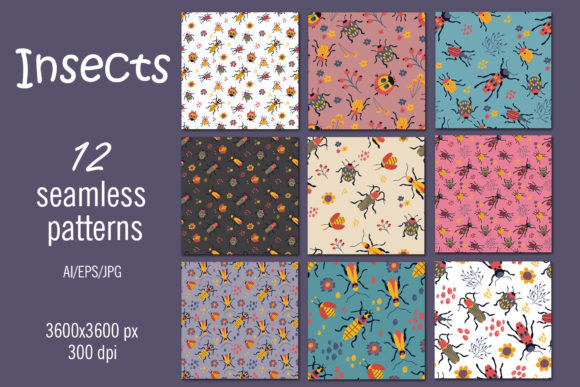
For designers, crafters, and small business owners who rely on repeatable, high-fidelity surface patterns, Insect - Digital Paper seamless Patterns offers a focused, production-ready resource. This collection—titled Insec—centers on stylized, nature-inspired insect motifs rendered as true seamless tiles. Unlike illustrative or decorative PNG overlays, these are built for functional repetition: they tile without visible seams, scale predictably, and maintain clarity across physical and digital outputs.
Purpose-Built for Real-World Repetition
The core strength of Insect - Digital Paper seamless Patterns lies in its technical execution. Each of the 12 patterns is delivered in three formats: EPS (vector), AI (editable Adobe Illustrator), and JPG (3600×3600 px, 12×12 inches at 300 dpi). That resolution isn’t arbitrary—it’s calibrated for print applications where detail matters: fabric swatches, gift wrap prototypes, planner cover mockups, or packaging dielines. The vector files allow infinite scaling without pixelation; the high-res JPGs provide immediate drag-and-drop utility in Canva, Procreate, or Affinity Designer without needing vector expertise.
Seamlessness here isn’t theoretical. Tested across multiple tiling workflows—including Photoshop’s “Offset” filter, Illustrator’s “Pattern Options,” and InDesign’s “Object > Pattern > Make”—each tile aligns cleanly edge-to-edge with no ghosting, misalignment, or color bleed. That reliability reduces time spent troubleshooting repeats, especially when adapting patterns to non-square surfaces like labels or garment panels.
Design Language and Visual Cohesion
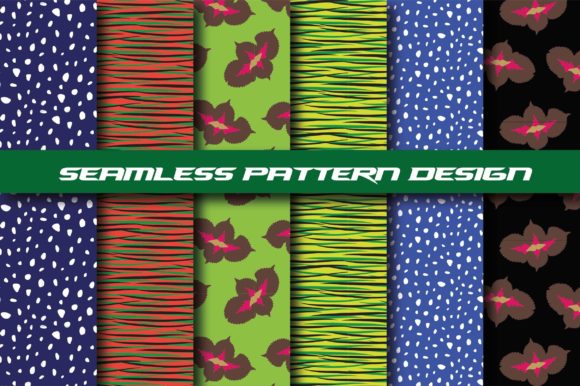
The Insec collection avoids literal entomology. Instead, it interprets insects through simplified silhouettes, rhythmic line work, and balanced negative space—think delicate moth wings arranged in radial symmetry, segmented beetle carapaces forming geometric grids, or stylized dragonfly forms layered in staggered rows. Colors are muted and palette-controlled (mostly earthy ochres, slate greys, deep forest greens, and off-whites), making them adaptable to both minimalist branding and tactile, artisanal aesthetics.
This restraint supports versatility. A pattern featuring overlapping cicada outlines works equally well as a subtle background for a wellness brand’s product label or as a bold textile print for a limited-run notebook collection. Because the motifs are stylized—not photorealistic—they avoid seasonal or cultural specificity, extending their usable lifespan across projects.
Practical Applications Across Disciplines
Insect - Digital Paper seamless Patterns serves distinct needs depending on the user’s workflow:
- Planner and journal designers use the JPG files directly in digital templates—layering them beneath text or icons without worrying about seam visibility on printed spreads. The 12×12 inch size fits standard disc-bound or coil-bound layouts with room for bleed.
- Fabric and packaging developers import EPS or AI files into textile design software (like Kaledo or Browzwear) to test drape behavior, scale shifts, and colorway variations before committing to physical sampling.
- Small-batch stationery makers apply patterns to kraft paper wrappers, greeting card bases, or sticker sheets—leveraging the 300 dpi resolution to ensure crisp edges even on uncoated stock.
- Educators and workshop facilitators use individual motifs as teaching tools for pattern theory: demonstrating repeat types (brick, half-drop, diagonal), symmetry operations, or the relationship between motif density and visual weight.
One practical observation: because the patterns are monochromatic or low-contrast by design, they respond well to spot-color printing or foil stamping. A user testing metallic gold foil over the “Ant Grid” pattern reported clean registration and minimal ink spread—something less predictable with busier, higher-contrast repeats.
Quality and Consistency Considerations
All 12 patterns share consistent stroke weights, spacing intervals, and motif sizing relative to the tile boundary. That uniformity matters when building multi-pattern collections—for example, pairing the “Butterfly Lattice” with the “Grasshopper Stripe” on a single product line. There’s no jarring jump in scale or line thickness that would require manual adjustment.
File naming is logical and descriptive (“Insec_07_BeeHive_Tile.ai”), avoiding cryptic codes. Metadata is embedded in EPS and AI files (including creator and copyright fields), supporting proper attribution in collaborative or client-facing environments. No fonts are embedded or required—the patterns are fully self-contained vector paths or raster layers.
Who Benefits Most—and When It May Fall Short
This set delivers strongest value to professionals who need dependable, editable, print-savvy patterns without commissioning custom work. Freelance surface designers preparing mood boards for home goods clients, indie publishers developing themed bullet journal kits, or eco-conscious packaging startups sourcing sustainable print assets—all gain measurable time savings here.
It’s less suited for users requiring full RGB or Pantone color libraries out of the box. While the JPGs are color-accurate, the base files ship in grayscale or limited palettes—intentionally, to support user-driven recoloring. That’s an advantage for flexibility but means additional steps if you need five pre-mixed brand-aligned variants immediately.
Similarly, while the insect theme is cohesive, it’s also specific. If your current project calls for botanical, architectural, or abstract geometry, this collection won’t stretch to cover those categories. Its focus is intentional—not a limitation, but a constraint that enables precision.
Integration Into Existing Workflows
Testing across common tools confirmed smooth interoperability. In Illustrator, dragging an AI file into a new document auto-generates a swatch. In Photoshop, the JPGs drop into smart objects and retain scalability up to 200% before interpolation artifacts appear. Even in Figma, using the JPGs as fill layers (with “Tile” enabled) produced clean repeats—though vector editing requires round-tripping to Illustrator first.
For long-term asset management, storing the EPS files in a centralized library (e.g., Adobe CC Libraries or a shared Dropbox folder with version control) ensures consistency across team members. One small business owner noted that reusing the “Ladybug Dot” pattern across her website background, business cards, and tote bag print reduced brand asset fragmentation by eliminating mismatched repeats across touchpoints.
A Measured Recommendation
Insect - Digital Paper seamless Patterns doesn’t try to be everything. It’s not a sprawling mega-pack with 100+ designs, nor does it include mockups, tutorials, or licensing add-ons. What it provides is 12 rigorously constructed, production-tested seamless patterns—delivered in formats that match real-world output requirements. For someone balancing quality, efficiency, and aesthetic coherence—especially in print-forward contexts—it’s a quietly effective tool. It earns its place not through novelty, but through reliability: the kind that shows up consistently in the final print run, the client presentation, and the shelf-ready product—without requiring last-minute fixes or workarounds.