Watercolor Calla Lily Seamless Patterns
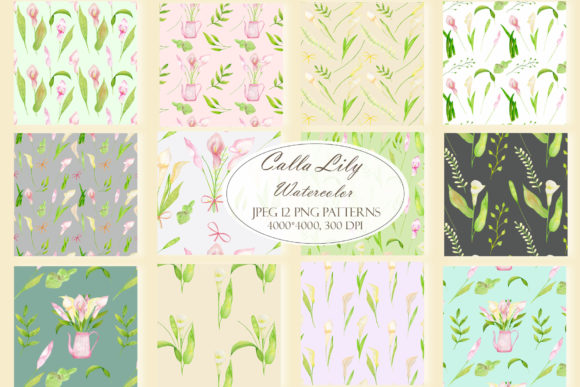
If you’ve ever stared at a blank greeting card, wrestled with fabric placement for a handmade dress, or spent 45 minutes trying to tile a background in Canva without visible seams—you’ll recognize the quiet relief that comes with a truly seamless, ready-to-use watercolor pattern. Watercolor Calla Lily Seamless Patterns deliver exactly that: twelve thoughtfully crafted, hand-painted calla lily motifs—delicate, soft-edged, and full of quiet elegance—designed to repeat flawlessly across any surface.
What Makes These Patterns Actually Work—Not Just Look Pretty?
It’s not just about aesthetics. A “seamless” pattern means the edges align perfectly when tiled—no awkward gaps, no misaligned stems, no jarring repeats that scream “digital shortcut.” These aren’t algorithm-generated repeats or traced vectors. Each calla is drawn by hand with watercolor washes, subtle granulation, and gentle pigment blooms—then carefully edited to preserve texture while ensuring clean, invisible joins. That tactile authenticity translates directly into real-world usability: whether you’re printing on kraft paper or laying down a textile print, the pattern breathes like real art—not a sterile clipart loop.
Real Moments When These Patterns Solve Real Problems
A small-batch stationery maker needs elegant, non-generic designs for wedding thank-you cards. She downloads one of the PNG files (with transparent background), drops it into her Illustrator template, adjusts scale to fit an A6 card front—and prints. No color correction needed. No worrying about white borders or pixelation. The soft watercolor grain holds up beautifully on matte cotton paper, giving her shop a signature look customers describe as “thoughtful, not trendy.”
A homeschooling parent preparing a botany unit prints two patterns onto sticker paper: one for labeling plant parts, another as a calming border on student worksheets. Because each file is 4000×4000 pixels at 300 dpi, she can shrink them to 2 inches tall or enlarge to poster size—no blurriness, no jagged edges. The delicate callas make science feel approachable, not clinical.
A freelance social media manager building a launch campaign for a luxury candle brand uses one of the JPGs as a subtle background layer behind product photos. She lowers opacity to 12%, adds a soft drop shadow, and suddenly the flat image gains depth and sophistication—without competing with the product. It’s branding done quietly, respectfully, and efficiently.
Where You’ll Use These—Beyond the Obvious
Yes, they work beautifully on greeting cards, invitations, and wrapping paper—that’s the entry point. But their versatility reveals itself in quieter, more practical ways:
- Fabric printing: Upload directly to Spoonflower or Printful. The high-res files ensure fine details—like the curve of a calla’s spathe or the whisper-thin veining—translate cleanly onto cotton voile or linen. Ideal for napkins, scarves, or quilt backing where subtlety matters more than boldness.
- Digital scrapbooking: The 11 PNGs include transparent backgrounds—so you can overlay them on photos, blend modes, or combine with handwritten journaling without clipping masks or guesswork.
- Educational printables: Teachers use them as gentle dividers between sections in reading logs or behavior charts. The organic flow calms visual overwhelm—especially helpful for neurodiverse learners who respond well to soft, predictable repetition.
- Branded digital assets: Slide decks, email headers, or even Zoom virtual backgrounds gain cohesion when built around a single, refined motif. One pattern used consistently across touchpoints builds recognition faster than flashy fonts or loud colors ever could.
What to Consider Before You Download or Design With Them
These patterns shine brightest when matched to your actual workflow—not just your aesthetic preferences. Ask yourself:
- Do you need transparency? If you’re layering over photos or colored backgrounds, reach for the PNGs. If you’re printing full-bleed wrapping paper or fabric, the JPGs are lighter, faster to process, and equally crisp.
- How much control do you want over color? All files are delivered in warm, natural tones—creamy whites, muted sage greens, faint blush undertones—but because they’re raster (not vector), recoloring requires basic photo editing skills. If you need exact Pantone matches or monochrome versions, plan time for adjustment in Photoshop or Affinity Photo.
- Is scale part of your message? A tightly spaced repeat feels intimate and detailed—perfect for stationery. A looser, larger-scale version reads as confident and airy—better for wall art or apparel. Try tiling one pattern at three different sizes before committing to a final layout.
Also worth noting: these are designed for personal and commercial use—including client projects and small-batch physical goods—but not for resale as standalone digital assets (e.g., uploading to Creative Market as your own pattern pack). That clarity protects both you and the creator—Oksana—who painted each calla with care, not code.
Why “Delicate” Isn’t Just a Buzzword Here
You’ll see phrases like “delicate callas drawn with love and tenderness” in the listing—and it’s not marketing fluff. Look closely at the petal edges: there’s intentional softness, slight variation in tone, tiny water blooms where pigment settled differently each time. That humanity matters. In a world saturated with hyper-polished AI-generated florals, these patterns carry the warmth of a real hand guiding the brush. That shows up in how people respond to things made with them: a handmade gift tag feels more personal; a teacher’s classroom poster feels more inviting; a boutique’s packaging feels more considered.
It’s the difference between something that looks *designed* and something that feels *given*.
Getting Started Is Simpler Than You Think
You don’t need Procreate or Adobe Suite to begin. Open one of the JPGs in Canva, drag it onto a blank canvas, and click “Tile Background.” Adjust spacing if needed—it’ll hold. For fabric, upload straight to your preferred printer. For stickers or labels, import into Silhouette Studio or Cricut Design Space and resize freely—the resolution holds. And if you’re just testing ideas? Zoom in. Print a 4×6 swatch. Tape it to your desk. See how the light catches the watercolor texture at different times of day. Let the pattern earn its place—not just fill space.
Because at its core, Watercolor Calla Lily Seamless Patterns isn’t about adding decoration. It’s about bringing intention, calm, and quiet beauty into the things you make—whether that’s a birthday card for your niece, a limited-run scarf for your Etsy shop, or a slide deck that helps your team actually listen.