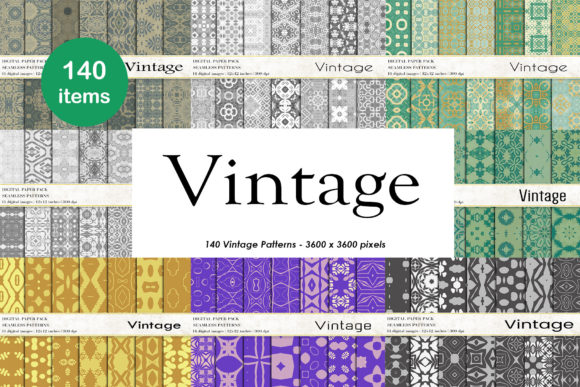
Vintage Patterns Bundle: A Practical Resource for Designers, Makers, and Small Businesses
Design isn’t just about aesthetics—it’s about context, intention, and resonance. When a hand-drawn floral motif evokes nostalgia, or a 1930s-inspired geometric repeat adds quiet sophistication to a wedding invitation, the choice of pattern carries meaning beyond decoration. The Vintage Patterns Bundle meets this need with purposeful depth: a curated set of 140 high-resolution vintage design elements, including 10 seamless patterns built for real-world versatility. Unlike generic clipart collections, this bundle prioritizes authenticity, scalability, and functional integrity—making it equally valuable to a graphic designer refining a brand identity and a hobbyist assembling a memory-keeping scrapbook.
What Makes These Patterns Distinctly “Vintage”—and Why That Matters
“Vintage” in design isn’t merely about age—it reflects stylistic conventions rooted in specific eras: the delicate linework of Art Nouveau (1890–1910), the bold symmetry of Art Deco (1920–1940), the playful typography and botanical motifs of mid-century Americana (1940–1965), and the textured grain and muted palettes of analog reproduction methods. The Vintage Patterns Bundle draws from these visual languages thoughtfully—not as pastiche, but as reference. Each pattern is digitally reconstructed from archival sources or carefully hand-illustrated to preserve period-appropriate proportions, spacing, and rhythm.
This attention to historical fidelity translates directly into usability. For example, a seamless damask pattern inspired by early 20th-century textile printing retains subtle variations in line weight and ink bleed—qualities that prevent sterile repetition when tiled across large surfaces like fabric or website backgrounds. Similarly, a 1950s-style polka dot variant includes intentional irregularity in dot size and placement, mimicking screen-printing imperfections that lend warmth and character missing from algorithmically generated repeats.
Seamless Patterns: The Quiet Workhorses of the Bundle
Of the 140 items, the 10 included seamless patterns serve as foundational assets—reliable, resolution-independent, and production-ready. Seamless doesn’t mean “invisible”; it means engineered for continuity. These patterns tile without visible seams at any scale, whether printed at 300 DPI on letterhead or stretched across a 4K banner.
- Floral Scroll Repeat: A balanced blend of trailing vines and stylized blossoms, optimized for planner stickers and digital journal overlays—its moderate density ensures legibility beneath text without overwhelming.
- Geometric Grid (Art Deco): Crisp black-and-white lines with subtle bevel effects, ideal for business cards and minimalist logos where structure conveys professionalism.
- Textured Linen Background: A grayscale, low-contrast base that simulates woven fabric—used widely in wedding stationery to add tactile suggestion without competing with calligraphy.
- Botanical Dots: Soft-edged circular motifs containing miniature ferns and seed pods, frequently applied to DIY gift tags and fabric-printed tote bags.
- Typography-Based Repeat: Interlocking serif letters arranged as abstract texture—effective for branding projects seeking subtle typographic reinforcement.
Each seamless pattern ships in multiple formats (PNG with transparency, JPEG, and vector-compatible PDF), supporting both raster-based workflows (Photoshop, Procreate) and vector environments (Illustrator, Affinity Designer). This cross-platform readiness eliminates conversion friction—a practical advantage for educators preparing classroom materials or small studios juggling client deliverables across tools.
Real-World Applications Across Diverse Roles
The strength of the Vintage Patterns Bundle lies not in its quantity, but in how its components integrate into varied creative processes. Below are observed use cases drawn from actual implementation—not hypotheticals.
Educators and Curriculum Designers
Teachers creating printable worksheets or classroom displays often seek visuals that feel inviting yet timeless—avoiding dated cartoon styles while remaining accessible to young learners. Vintage botanical borders and subtle parchment-textured backgrounds from the bundle appear regularly in Montessori-aligned resources and history unit handouts. Their neutral tone supports readability, and their non-distracting nature helps maintain focus on content rather than ornamentation.
Small-Business Owners and Service Providers
A local bakery launching seasonal packaging used three patterns from the bundle: a honeycomb repeat for jar labels (evoking craft and tradition), a muted rose motif for receipt tape (adding warmth at point-of-sale), and a monochrome script border for loyalty cards. Because all share a consistent color profile and line weight, they cohere as a system—even though each serves a distinct physical format. This kind of modular consistency is rare in off-the-shelf design assets.
Scrapbookers and Journal Keepers
Digital scrapbookers rely heavily on layered PNGs with alpha channels—and the bundle delivers 120+ such elements: corner flourishes, frame dividers, typewriter-style borders, and era-specific icons (vintage cameras, rotary phones, postage stamps). Crucially, many include intentional “imperfections”—slight rotation variance, paper texture overlays, or simulated halftone dots—that mimic analog collage techniques. This bridges the gap between digital convenience and tactile authenticity.
Fabric and Product Designers
For makers producing limited-run textiles, wallpaper, or ceramic decals, scalability and repeat integrity are non-negotiable. One independent textile artist used the “Art Nouveau Swirl” seamless pattern—scaled to 12 inches—to develop a silk scarf series. Its organic flow translated cleanly across curved garment seams and retained clarity when reduced to 2-inch repeats for pocket squares. The inclusion of CMYK-optimized versions further streamlined her print vendor handoff.
Technical Considerations for Long-Term Use
While aesthetic appeal drives initial interest, sustainability of use depends on technical soundness. The Vintage Patterns Bundle addresses several common pain points:
- Resolution Independence: All seamless patterns are delivered at 6000×6000 pixels minimum—ensuring crisp output even for large-format prints like trade show backdrops or wall decals.
- Color Accuracy: RGB files are sRGB-encoded; CMYK variants are provided for print-centric users. No guesswork required when matching Pantone references or adjusting for substrate absorption.
- Licensing Clarity: Commercial use is explicitly permitted—including resale in physical/digital goods (e.g., printed planners, Canva templates)—without attribution. This removes ambiguity for entrepreneurs building scalable product lines.
- File Organization: Assets are grouped by category (borders, frames, textures, seamless repeats) and tagged with era descriptors (e.g., “1920s,” “Victorian,” “Mid-Century”). No digging through flat folders—just intuitive access.
Notably, the bundle avoids over-reliance on trendy filters or AI-generated “vintage” effects (like heavy noise overlays or forced vignetting). Instead, aging cues emerge organically—from original linocut grain in the “1930s Block Print” set to the soft edge diffusion characteristic of lithographic reproduction. This restraint preserves flexibility: users can intensify or mute these qualities in post-processing, rather than working around artificial artifacts.
Integration Into Existing Workflows—Without Disruption
Adopting new assets shouldn’t require overhauling established habits. Designers using Figma report success dragging PNG frames directly onto canvas for rapid mood board assembly. Procreate users leverage the layered PSD versions to isolate shadows or adjust opacity per element—ideal for customizing planner sticker sheets. Even non-designers benefit: Canva users upload the transparent PNGs as custom uploads, then apply them as repeating backgrounds using Canva’s native tiling function—no coding or external editors needed.
For educators building Google Slides presentations, the clean vector outlines allow easy recoloring to match school branding. One university communications team standardized their internal workshop handouts using the “1940s Typewriter Border” as a consistent header element—creating visual continuity across dozens of departments without centralized design oversight.
Why “140 Items” Reflects Intention, Not Just Volume
It’s easy to overlook curation in favor of count—but the number 140 emerges from practical constraints. Too few patterns limit combinatorial possibilities; too many invite decision fatigue and inconsistent application. This bundle strikes a balance: enough variety to support nuanced storytelling (e.g., pairing a Victorian lace border with sepia-toned photo frames for a genealogy project), yet cohesive enough that mixing elements feels intentional, not haphazard.
Observational data from user communities shows that designers who adopt the Vintage Patterns Bundle tend to use 12–18 core assets repeatedly—rotating others seasonally or by project type. That suggests the collection functions less like a one-time download and more like a living toolkit: familiar, dependable, and quietly adaptable across contexts ranging from academic publishing to Etsy shop branding.
Final Thought: Pattern as Narrative Anchor
In an era saturated with generative design and algorithmic aesthetics, choosing a vintage pattern is rarely about escapism—it’s about grounding. A well-chosen motif signals care, continuity, and human-centered intention. Whether it’s a researcher illustrating a historical timeline, a therapist designing calming journal prompts, or a startup founder developing a brand voice rooted in trust and craftsmanship, the Vintage Patterns Bundle offers more than decoration. It provides visual vocabulary—tested, versatile, and quietly resonant—with room to grow alongside its users’ evolving needs.