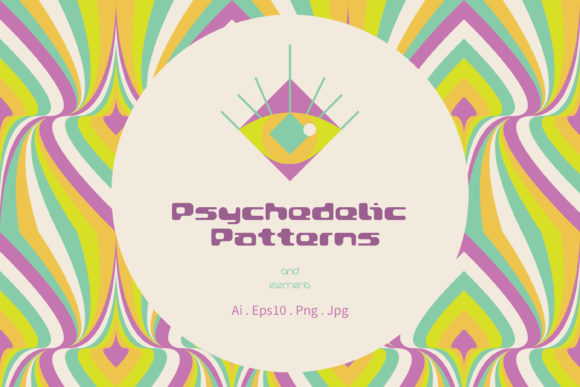
Psychedelic Patterns and Elements
Design today isn’t just about clarity—it’s about resonance. As audiences grow more visually literate and emotionally selective, creators are turning to motifs that balance boldness with intentionality. Psychedelic Patterns and Elements meets that need precisely: a curated collection of 15 seamless, geometry-driven patterns and 10 versatile design elements—each built with vivid, harmonized color palettes and precise vector construction. It’s not retro nostalgia repackaged; it’s surreal elegance recalibrated for contemporary use across branding, print, digital, and physical spaces.
A Shift Toward Intentional Visual Language
Over the past five years, “psychedelic” has evolved beyond countercultural shorthand. In design contexts, it now signals layered meaning—complexity with control, vibrancy with structure, playfulness with precision. This shift reflects broader changes: consumers respond more strongly to visuals that feel both human-made and thoughtfully engineered. Brands in wellness, indie publishing, boutique fashion, and creative education increasingly adopt stylized abstraction—not as decoration, but as tonal shorthand. A geometric spiral or interlocking mandala pattern can convey curiosity, transformation, or depth without relying on literal imagery.
What makes Psychedelic Patterns and Elements relevant in this landscape is its restraint. These aren’t chaotic overlays or over-saturated gradients. Each pattern is constructed using deliberate symmetry, modular repetition, and calibrated contrast—allowing designers to introduce visual energy while preserving legibility and brand coherence. The 10 design elements (think ornamental frames, radial glyphs, tessellated icons) function like visual punctuation: subtle enough to support typography or photography, strong enough to anchor a layout.
Designed for Real Workflows—Not Just Inspiration
Modern creative work demands flexibility without compromise. That’s why Psychedelic Patterns and Elements ships with multiple file types tailored to specific production needs—not as an afterthought, but by design. The two AI CS6 files separate patterns from elements cleanly, making it easy to adapt assets within existing brand systems. Each of the 25 EPS10 files ensures compatibility with legacy and current vector workflows, whether you’re prepping files for textile printers or refining assets in Illustrator.
The high-resolution JPGs (5000×5000 px, 300 dpi) serve practical print applications—wallpaper mockups, packaging prototypes, fabric swatches—without pixelation or scaling guesswork. Meanwhile, the dual PNG sets offer distinct utility: the 15 pattern PNGs provide ready-to-layer textures for digital presentations or social media templates; the 15 element PNGs—with transparent backgrounds and consistent 5000 px height—drop seamlessly into UI kits, presentation decks, or branded email headers.
This level of technical consideration reflects how professional design tools have changed. Designers no longer choose between aesthetic richness and production readiness—they expect both. Whether you’re a freelance graphic designer building a client’s stationery suite, an educator creating workshop materials, or a small-batch maker designing product labels, having assets that scale, layer, and convert reliably saves time and reduces revision cycles.
Beyond Aesthetics: Where Pattern Meets Purpose
Patterns do more than fill space—they shape perception. Research in environmental psychology shows that repetitive, rhythmically structured visuals can influence mood, attention span, and even perceived time. A well-placed geometric pattern on packaging, for example, can slow down scrolling behavior in digital catalogs or encourage longer dwell time in physical retail settings. Similarly, wall art featuring layered psychedelic motifs often serves as intentional focal points in co-working spaces or therapy offices—supporting atmosphere without overwhelming.
Psychedelic Patterns and Elements supports these nuanced applications because its geometry is grounded—not arbitrary. Triangular lattices, concentric polygons, and fractal-inspired tessellations follow mathematical logic, lending stability to their vibrancy. That structural integrity means they hold up under resizing, cropping, or color adjustment. You can recolor a pattern to match a brand’s secondary palette, reduce saturation for a muted luxury effect, or invert tones for dark-mode interfaces—all without breaking visual cohesion.
Practical Use Across Industries
Consider how these assets integrate across real-world scenarios:
- Branding & Identity: Use one of the seamless patterns as a subtle background texture behind logo lockups or business cards—adding dimension without competing with core messaging.
- Packaging Design: Apply a border element from the set along the edge of a cosmetic box or artisanal food label to signal handcrafted quality and sensory appeal.
- Digital Products: Layer a low-opacity pattern PNG behind a testimonial section on a SaaS homepage to create gentle visual rhythm and improve readability.
- Textile & Surface Design: Tile a pattern across fabric for limited-run apparel or home goods—its 5000×5000 px resolution ensures crisp output at garment scale.
- Educational Materials: Incorporate an element as a recurring icon in a mindfulness course workbook—reinforcing thematic continuity without visual fatigue.
None of these uses require advanced technical skill. Because each asset is delivered individually and consistently formatted, experimentation is low-risk and fast. You don’t need to build from scratch—you refine, combine, and contextualize.
Why Now? Timing, Tools, and Taste
Three converging factors make collections like Psychedelic Patterns and Elements especially valuable right now. First, design tool accessibility has increased dramatically—more people use Figma, Canva, or Affinity apps alongside Adobe suites. Having assets in universally supported formats (EPS, PNG, JPG) removes friction across platforms.
Second, audience expectations have shifted toward authenticity *and* polish. Consumers notice when a brand’s visual language feels generic or algorithmically generated. Hand-crafted, conceptually anchored patterns communicate care—and that perception translates directly to trust and engagement.
Third, sustainability in design practice matters more than ever. Reusing rigorously built, scalable assets reduces redundant labor and minimizes version sprawl. Instead of redrawing similar motifs for every new project, designers invest once in a versatile toolkit—and return to it with confidence.
Thoughtful Design, Not Trend Chasing
It’s worth noting what Psychedelic Patterns and Elements doesn’t do: it doesn’t promise viral virality, nor does it claim to “solve” branding. It offers something quieter but more durable—a set of tools calibrated for longevity, adaptability, and quiet sophistication. Its strength lies in how easily it integrates rather than dominates: a pattern becomes part of your system, not the system itself.
Mona Ahmed’s approach—blending mathematical precision with chromatic vitality—reflects a growing preference among professionals for resources that respect their expertise. You’re not handed a template to fill; you’re given vocabulary to articulate your own voice more clearly.
In an era where attention is fragmented and visual noise is constant, choosing patterns and elements that carry weight—without shouting—isn’t just stylistic. It’s strategic.